Dr. Keith
The Caine MutinyDr. Keith is Willie Keith’s father, a physician whose impending death transforms their restrained father-son relationship into a final act of counsel. He conceals the severity of his illness to avoid spoiling Willie’s departure, then leaves a letter that turns regret over his own life into an appeal for his son to make better choices. His last words reach Willie not in a bedside farewell but in writing, after Willie has reported for duty.
Identity and Family Role
Dr. Keith appears as a thoughtful, physically ailing man whose private manner differs from the confident performance Willie gives before the family. At a gathering, Willie entertains listeners with improvised accounts of naval life and the war, despite having gone weeks without reading a newspaper. It is only when the party moves into the living room that Willie notices his father limping and using a cane. Dr. Keith then interrupts the questioning and takes his son into the library for a private conversation. The movement from the company’s eager attention to a closed-door exchange establishes a space in which Willie is not expected to perform as a sailor or an expert.
The library’s mahogany panels and shelves of collected authors alongside older best sellers give their conversation a setting associated with reading and reflection. Dr. Keith leans on his cane and asks how naval life is really going. When Willie asks about the leg, his father minimizes the problem as an infected toe. The gap between that brief explanation and the grave truth disclosed later gives the earlier exchange a painful retrospective force: Dr. Keith is already ill, but does not tell his son what the illness means.
Counsel and the Son’s Unease
Dr. Keith asks about Willie’s prospects without treating military service as a simple measure of worth. He recalls that he never went overseas during World War I and suggests that Willie might likewise be spared. Willie answers that he will accept what comes and wonders whether, if he proves capable, he ought to go overseas. The exchange leaves the father’s hope for his son’s safety beside Willie’s sense that service and danger may be tests he should meet.
He also notices a change in Willie before Willie is ready to claim one. Dr. Keith studies his son’s face and asks whether the Navy is changing him; Willie dismisses the possibility and calls himself the same inadequate person as before. The question is perceptive rather than conclusive: the evidence does not show Dr. Keith naming what has changed, but it does show him looking for a difference Willie cannot yet acknowledge. He asks whether Willie still has a chance to play the piano, too, keeping their private conversation connected to an earlier, nonmilitary part of his son’s life.
When Willie later faces trouble involving May Wynn, he chooses to tell his father rather than his mother, because he cannot predict how his mother will take the news and prefers to disclose the difficulty to a man. He gives only a brief account of May’s part in it. Dr. Keith lights a cigar and watches him as though his expression conveys more than his words. The moment presents him as an attentive confidant, though not as someone who resolves the problem for Willie.
The Letter and the Hidden Illness
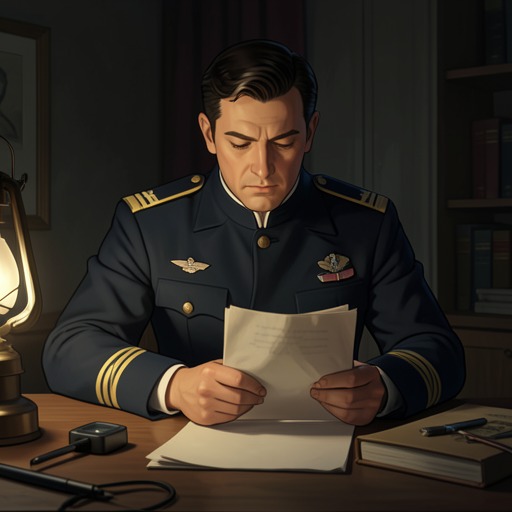
After Willie has reported for duty, he finds the letter his father had instructed him to open then. Expecting that months might pass before he reached his ship, Willie had treated his temporary duty as a possible reason to postpone opening it; when he finally reads it, the first words make him start up. He continues on the edge of a chair, the letter trembling in his hands as his cigarette burns down and its ashes fall unnoticed. The physical details mark the abrupt change from routine to bereavement before the letter’s full contents have been absorbed.
Dr. Keith explains that the infected toe is a malignant melanoma, that the prognosis is hopeless, and that he expects to live only three or four weeks. He has known of the disease for some time. Although he believes he should already be in hospital, he has postponed going because he does not want to spoil Willie’s departure and sees no hope of recovery. He has also kept the diagnosis from Mrs. Keith. His silence is therefore deliberate and costly: he has protected the departure he wants his son to make, while leaving Willie to learn the truth only after he has gone.
Regret, Blessing, and Narrative Significance
The letter’s illness disclosure leads into Dr. Keith’s account of the life he thinks he failed to live. He regards himself as having accomplished little and describes his life as second-rate, especially against his father’s example and his own abilities. He had an interest in research and imagined that he might return to it after ten or fifteen years of general practice in a high-income community. He chose that path because he believed he could not marry Willie’s mother without first earning in that way. He believes he might have contributed to cancer research: he had an idea that would have required three years of systematic investigation, but says no one has pursued it. His regret is not a rejection of his marriage; he says he has no regrets about Mrs. Keith as a wife. Rather, he mourns the research life he traded away and never resumed.
Dr. Keith asks Willie to care for his mother if she lives to old age and to be kind to her if he returns from the war with enough strength to break away from her. He acknowledges both her faults and her goodness, and affirms that she has loved them both truly. The request is practical as well as affectionate: his last counsel concerns Willie’s future obligations within the family, not only his private ambitions.
Most decisively, he tells Willie to remember him at the crossroads of his own life and to take the right turns for the sake of a father who believes he took the wrong ones. He sends his blessing and justification, recalls that he once liked to kiss Willie as a baby, and ends by urging him to be a man. Willie sobs as he reads the letter through tears. Dr. Keith’s role is thus brief but consequential: his concealed diagnosis, candid self-assessment, and appeal to his son make the letter a posthumous-seeming inheritance of judgment and responsibility, without suggesting that Willie’s future choices are already settled.